
Your cart is currently empty!
Riding Classes vs Learning on Your Own: An Honest Comparison
Many people want to learn to ride a motorbike, but the first big question is how. Do you teach yourself in an empty lot, or join a proper riding class? Both paths sound simple. Both have real trade offs. If you feel nervous about a heavy geared machine, you are not alone. Around 70 percent of the women who join our academy had never ridden even a bicycle before. This honest comparison looks at what self learning gives you, where it quietly fails, and what structured Royal Enfield coaching programs add. By the end, you will know which path fits your goals, your budget and your comfort level.
Key Takeaways
- Self learning feels cheap and flexible, but it hides real gaps in clutch control, road awareness and safe habits that are hard to unlearn later.
- Structured classes give small coach to learner ratios, a clear step by step plan and coaches trained to teach nervous first timers, not just to ride.
- The right choice depends on your confidence, your timeline and how much risk you are willing to carry while you learn.
The appeal of learning on your own
Learning on your own has a strong pull. It feels free. You pick your own hours, your own field and your own pace. There is no schedule to follow and no one watching. For many people who want to learn to drive a motorcycle, this freedom is the whole appeal. You borrow a bike from a friend, find a quiet ground and start rolling. It costs almost nothing up front, and that matters when budgets are tight.
There is also a private comfort to it. A nervous first timer often dreads making mistakes in front of others. Practising alone removes that fear. You can stall the engine ten times and no one sees. You can go as slow as you like. Some riders enjoy the sense of figuring things out by trial and error. It can feel like a personal adventure. This is real, and we respect it. Many of our own learners tried this route first before joining us. The instinct to protect your dignity while you fumble is human. A Royal Enfield is a geared machine, not a gearless scooter, so the early fumbling is guaranteed. Learning quietly, on your own terms, feels like the gentlest way to begin. The problem is what this comfort quietly hides, and that is where the picture changes.
The hidden risks of self learning
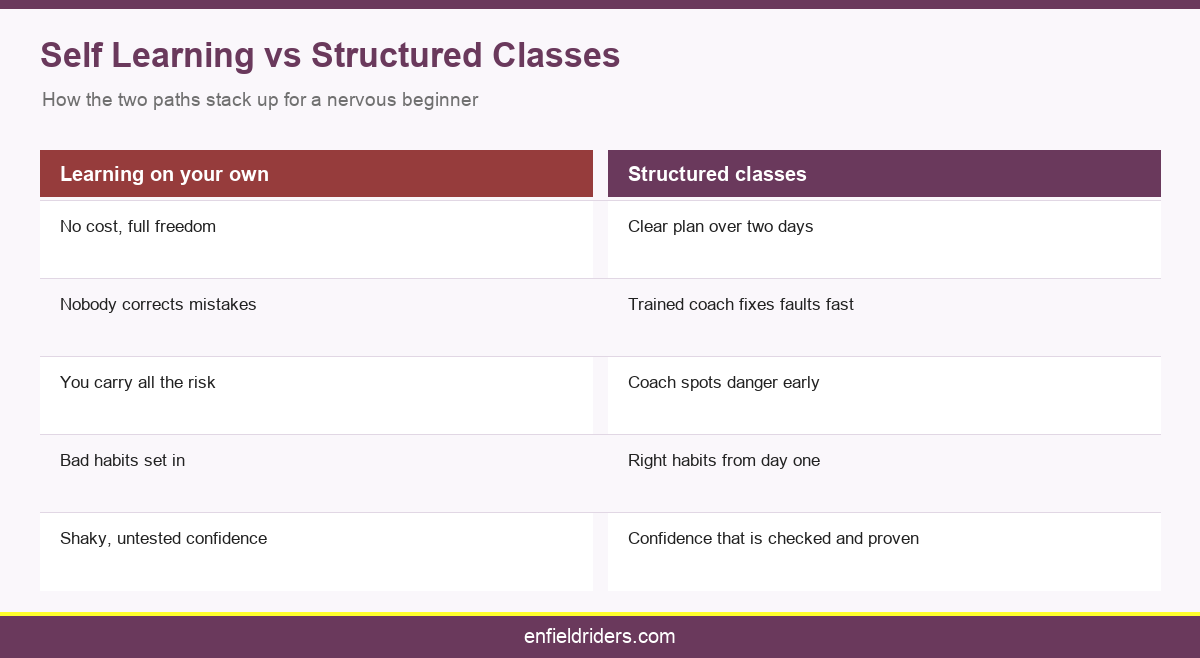
The trouble with self learning is that no one corrects you. Bad habits set in fast and feel normal. You might ride the clutch wrong, brake with only one hand, or lean the wrong way in a turn. Nobody flags it. Months later, these habits are baked in, and they are much harder to fix than to learn right the first time. What felt like progress was often practice of the wrong thing.
The clutch friction zone is the clearest example. It is the core beginner skill on any geared motorcycle, and it is easy to get subtly wrong. A small error here shows up later as jerky starts, stalls in traffic and low control at slow speed. Safety is the bigger worry. Alone, you have no one to spot danger, no one to stop you before a fall, and no structured way to build road sense. Official road safety guidance from the Ministry of Road Transport stresses trained, defensive riding for good reason. Self learners also often skip the licence process and paperwork on the Parivahan portal, riding before they are ready. The cost you save up front can return as a fall, a damaged bike or a frightening near miss. For a nervous beginner, that risk is not small.
What structured classes add
Structured classes fix the exact gaps that self learning leaves open. The first thing they add is a trained eye. Our coaches are trained to teach beginners, not just to ride well themselves. That difference is huge. A great rider cannot always explain why you keep stalling. A trained coach can watch your hand, name the fault and fix it in minutes. You skip weeks of guessing.
The second thing classes add is a plan. Our foundation course runs 12 hours across two days and builds skill step by step, from balance to clutch control to slow turns. The advanced course runs 8 hours across two days for riders who want to go further. Small groups keep the attention personal. We hold one coach to four learners in foundation, one to three in advanced, and one to one in the personalised track. You are never lost in a crowd. Because we run the Women Motorcycle Coaching Academy, the space is women first and judgment free, which matters when most learners start from zero. We have trained more than 10,000 women since 2014 and hold 1,230 excellent rider reviews. These rider reviews show the same pattern again and again. People who feared the bike leave riding it with real, tested confidence, not guesswork.
Time safety and confidence compared
Put the two paths side by side and the gaps get clear. On time, self learning feels faster to start but is slower to master. You spend weeks repeating errors nobody corrects. Good motorcycle driving lessons compress that curve. In two structured days, a coach moves you through balance, clutch and slow control in the right order. There is less wasted effort and far less relearning later. Fast at the start does not mean fast overall.
On safety, the difference is sharper. Alone, you carry all the risk yourself, with no one to spot a fault before it becomes a fall. In a class, a coach stands ready and the ground is controlled. On confidence, the contrast is the biggest. Self taught riders often feel shaky in traffic because they never tested their skills under guidance. Learners who take proper motorcycle driving lessons build confidence that has been checked and proven, not just hoped for. When you learn motorcycle skills with someone watching and correcting, you trust yourself sooner. That trust is what carries you onto real roads. For a nervous first timer, especially a woman starting from zero, this earned confidence is often the single most valuable thing a structured class gives. It is the part self learning almost never delivers on its own.
Making the right choice
So which path is right for you? Be honest about three things. First, your confidence. If a heavy geared bike scares you, or you have never balanced on two wheels, self learning will likely stall you and shake your nerve. A guided start suits you better. If you already ride confidently and only want to sharpen a skill, careful solo practice can work for small gains.
Second, your timeline. If you want to be road ready in a set window, a two day structured course gives you a clear finish line. Open ended solo practice can drag for months with no marker of progress. Third, your appetite for risk. Every fall, every bad habit and every near miss is a hidden cost of going alone. If you would rather not carry that, a class removes most of it. For most true beginners, and especially women starting from zero, the honest answer is that structured coaching wins on safety and confidence, while self learning wins only on up front cost and privacy. If you decide to learn to ride a motorbike the guided way, we run foundation courses in cities across India, each built around the same small group, women first method that has worked for thousands.
Conclusion
Both paths can get you moving, but they carry very different costs. Self learning saves money and protects your privacy, yet it quietly loads you with risk, bad habits and shaky confidence. Structured classes cost more up front and add real safety, a clear plan and trust in yourself that has been tested. For most first timers, and especially women starting from zero, guided coaching is the honest winner. If you are ready to learn the right way, in a small, women first, judgment free setting, talk to our team and book your foundation course. We will meet you exactly where you are and take it step by step.
Frequently Asked Questions
It feels hard at first, but it is very learnable. Around 70 percent of our women learners had never ridden even a bicycle. With small groups and step by step coaching, most gain real control within two days.
You can start alone, but a Royal Enfield is a geared machine, not a scooter. The clutch friction zone is easy to learn wrong. Without correction, small faults become stubborn habits that are hard to fix later.
Our foundation course runs 12 hours across two days. It moves you through balance, clutch control and slow turns in the right order. The advanced course adds 8 hours across two days for riders who want more.
We keep groups small so attention stays personal. It is one coach to four learners in foundation, one to three in advanced, and one to one in the personalised track. You are never lost in a crowd.
Yes. We run the Women Motorcycle Coaching Academy as a women first, judgment free space. Most learners start from zero, so nervous beginners fit right in. Coaches are trained to teach, not just to ride.
We run foundation courses in several cities across India, including Bangalore and Hyderabad. Each city uses the same small group, women first method, so the quality stays consistent wherever you choose to learn.
You should follow the official licence process on the Parivahan portal. Structured classes teach you safe control first, so you are genuinely ready to ride before you take your skills onto public roads.
Almost always, yes. Self taught riders often feel shaky because no one tested their skills. In classes, a coach checks and corrects you, so the confidence you build is proven rather than just hoped for.
It can suit a confident rider polishing one small skill, or someone with a very tight budget and no deadline. For true beginners worried about safety, structured coaching usually wins on every measure that matters.
by
Tags: