
Your cart is currently empty!
Getting Your Motorcycle Licence in India: A Rider’s Guide
If riding feels out of reach, you are not alone. Many beginners feel nervous before they even sit on a bike. Good motorcycle license training makes the whole journey calmer and clearer. This guide walks you through the licence you need, the learner steps, the riding test and the support that helps you pass. At Enfield Riders, we have trained more than 10,000 women since 2014. Around 70 percent of them had never ridden even a bicycle before. That tells us one simple thing. With patient teaching, anyone can learn. Read on, and take each step at your own pace.
Key Takeaways
- A geared Royal Enfield needs a licence for gear vehicles, not the gearless category, so pick the right class from the start.
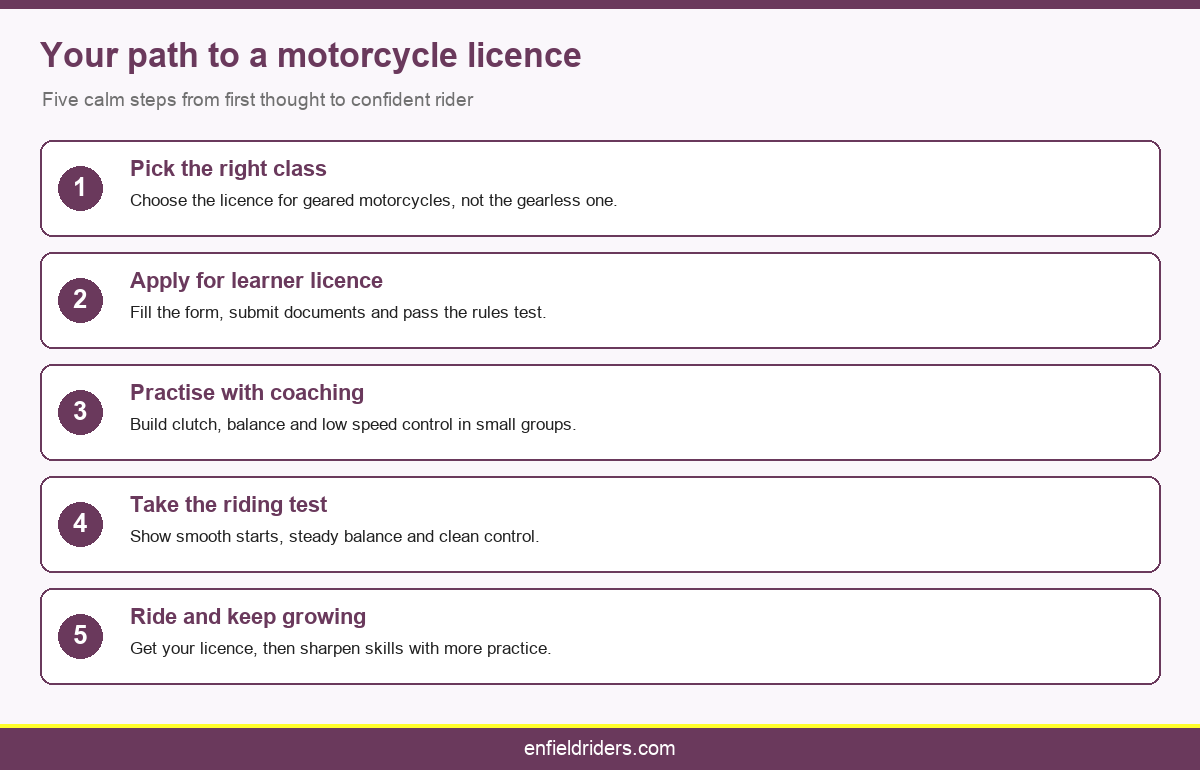
- The path runs learner licence first, then practice, then the riding test, then your permanent licence.
- Structured coaching with a low learner to coach ratio builds real clutch and balance skills, so you face the test with calm confidence.
The licence you need to ride
Before you book any test, know which licence class fits your bike. A Royal Enfield is a geared motorcycle, not a gearless scooter. That difference matters for your paperwork. In India, a gearless two wheeler up to a set engine size has its own category. A geared motorcycle sits in a separate class that allows you to operate the clutch and gears. If you plan to ride an Enfield, you need the licence that covers gear vehicles.
Getting the class right from day one saves time and stress. The Parivahan licence portal lists the current vehicle categories and age rules in plain terms. Read them before you apply, so your learner licence matches the bike you want to ride. Good motorcycle license training starts with this clarity. When you understand the correct motorcycle license class, every later step feels simpler. At our academy, coaches explain this early, so you never feel lost in the rules. We want you focused on the bike, not confused by forms. Many first timers assume one licence covers everything. It does not. A gearless permit will not let you legally ride a geared Enfield. So confirm the class, then move ahead with confidence. This small check protects you from wasted trips to the transport office and keeps your learning smooth from the very first day you begin.
Learner licence steps
Your first official step is the learner licence. This is a short term permit that lets you practise under supervision. The process is simpler than most beginners expect. You apply online, submit your documents, and take a small test on road rules and signs. Once you pass, you receive your learner licence and can begin practice.
Start on the Parivahan licence portal, where you fill the application and upload proof of age and address. You then book a slot for the learner test. This test checks that you know basic traffic signs, signals and safe habits. It is not about riding skill yet. A little reading beforehand goes a long way. The Ministry of Road Transport road safety pages cover the signs and rules you should know. Study them calmly over a few evenings. Once you hold the learner licence, you can begin real practice on a geared bike. This is the perfect time to join a structured motorcycle license course, so you build correct habits from the start. Practising alone with a nervous friend often teaches fear, not skill. A proper program gives you a safe space, a steady bike and a coach who has taught many beginners before you. That foundation carries you into the riding test with far less worry. Take these early steps seriously, and the rest of the journey feels lighter and more within reach every week.
Preparing for the riding test
The riding test checks whether you can control the motorcycle safely and confidently. For a geared Enfield, this means smooth starts, steady balance and clean gear changes. The clutch friction zone is the core skill here. It is the point where the clutch begins to grip and the bike starts to move. Master it, and slow control feels natural instead of scary.
Practice the basics until they feel automatic. Move off smoothly without stalling. Ride slowly in a straight line. Turn in a controlled circle. Stop gently and put a foot down with balance. Examiners want to see calm, safe handling, not speed. A structured motorcycle license course builds these exact skills in order, so nothing feels rushed. Our foundation course runs 12 hours across two days, which gives real time to practise. With a one to four coach to learner ratio, you get close attention on every attempt. That means a coach spots your clutch timing and corrects it gently, before bad habits form. Many learners fail the riding test only because nerves take over on the day. Steady practice removes that fear. When your hands and feet know the movements, your mind can stay calm. Arrive rested, breathe slowly and trust the routine you have built. Preparation is not about being perfect. It is about being ready enough that the test feels like just another practice ride you have already done many times before with support beside you.
How coaching helps you pass
You can learn to ride from a friend, but structured coaching changes the whole experience. Coaches who are trained to teach beginners see what you cannot see. They watch your clutch hand, your eyes and your balance, then correct small errors early. This is very different from someone who can ride well but has never taught a nervous first timer.
At our women first academy, the numbers show why teaching matters. Around 70 percent of our learners had never ridden even a bicycle before they started. Yet they learn, because the method is built for absolute beginners. Our foundation course is 12 hours over two days, with a one to four ratio. The advanced course is 8 hours over two days, at one to three. Personalised coaching is one to one, for those who want full private attention. Small groups mean real practice time, not standing in a queue. We hold 1,230 excellent rider reviews from people who once felt exactly as unsure as you do now. This kind of motorcycle license training does more than help you pass a test. It builds lasting confidence on the road. You leave knowing how to handle the clutch friction zone, how to balance at low speed and how to stay calm in traffic. That is a skill for life, not just a certificate. Good teaching turns fear into freedom, one steady session at a time, at a pace that suits you.
After you get your licence
Passing the test is a proud moment, but it is the start, not the finish. A permanent licence means you can ride legally, yet real confidence grows with more practice. Your first weeks on the road should build on what you learned, calmly and safely. Ride familiar routes first. Keep your speed gentle. Let your skills settle before you take on heavy traffic.
Keep practising the clutch friction zone and low speed control, since these matter most in busy Indian roads. If you feel shaky in traffic or on slopes, that is normal. Many riders return for an advanced course to sharpen these exact skills. Our advanced program runs 8 hours over two days, with a one to three ratio, so you get close guidance on trickier situations. You can explore the full range of Royal Enfield coaching programs whenever you feel ready for the next step. Riding a genuine Royal Enfield is a joy, and it deserves steady, confident handling. Stay curious and keep learning. Wear your gear every ride. Check your mirrors and signals until they become second nature. The road rewards riders who respect it. Most of all, enjoy the freedom you have earned. Every skilled rider once sat where you sit now, unsure and nervous. You crossed that line. Now build on it, ride safely and let each journey make you a calmer, stronger rider than the last.
Conclusion
Getting your motorcycle licence in India is very doable when you take it step by step. Pick the right class, get your learner licence, practise well and face the test calmly. The right motorcycle license training turns nerves into confidence, especially for first timers. We have guided more than 10,000 women through this exact journey since 2014, most of whom had never ridden before. You can do this too. If you are ready to learn on a real geared Royal Enfield with patient, beginner friendly coaches, book your foundation course today. Take the first step, and let us ride the rest of the way with you.
Frequently Asked Questions
Yes. A Royal Enfield is a geared motorcycle, so you need the licence class that covers gear vehicles, not the gearless scooter category. Confirm the correct class before you apply for your learner licence.
Our foundation course runs 12 hours across two days, which suits most beginners. The advanced course is 8 hours over two days. Personalised one to one coaching adjusts fully to your own pace and comfort level.
Absolutely. Around 70 percent of our learners had never ridden even a bicycle before starting. Our beginner friendly method and small groups mean you learn safely, step by step, from the very first session.
For most beginners it is the clutch friction zone, the point where the clutch grips and the bike moves. Structured coaching makes this feel natural, so slow control and smooth starts stop feeling scary.
Yes. Enfield Riders runs a women first coaching academy built for beginners. You can read about our women first approach and see why many nervous first timers feel safe learning with us.
Our coaches are trained to teach beginners, not just to ride. That means they spot and fix small errors early. You can read our rider reviews from 1,230 happy learners to judge the difference.
Focus on traffic signs, signals and safe road habits. The Ministry of Road Transport road safety pages cover these clearly. A few calm evenings of reading is usually enough to pass this rules based test.
We run foundation courses in several Indian cities, including Bangalore and Pune. Check the city page nearest you to see available foundation course dates and book a slot that fits your schedule.
You receive your permanent licence and can ride legally. Keep practising low speed control and the clutch friction zone. Many riders return for the advanced course to build confidence in busy traffic and on slopes.
Our foundation course has a one to four coach to learner ratio. The advanced course is one to three, and personalised coaching is one to one. Small groups mean real practice time and close attention on every attempt.
by
Tags: