
Your cart is currently empty!
How to Lift a Fallen Motorcycle, Push and Park a Royal Enfield
Every new rider worries about the same moment: the bike tips over and you have to pick it up. Knowing how to lift a fallen motorcycle turns that fear into a routine you can practise. A Royal Enfield Classic 350 or Bullet 350 weighs 195 kg, yet coaches lift them with legs, not arms. This guide covers the lift, pushing on slopes and parking without strain. For the numbers behind each model, see our guide to weight and seat height by model.
Key Takeaways
- Learning how to lift a fallen motorcycle is about leg drive and body position, not upper body strength.
- Push a heavy Royal Enfield from the left side with the bike leaning into your hip and a finger on the front brake.
- Park nose out on firm, level ground, and on any slope leave the bike in first gear.
How to lift a fallen motorcycle with the back to the seat method
The back to the seat lift lets almost any rider raise a Royal Enfield. You turn your back to the seat, hold the low handlebar and a solid frame point, and walk the bike up with small steps. Your thighs do the work, so your back stays straight and your arms only hold on.
Start by switching off the ignition and taking a breath. Look for leaking fuel or a hot exhaust before you touch anything. If the bike lies on its right side, flip the side stand down first so it is ready when the bike comes up. Then shift into first gear so the rear wheel cannot roll.
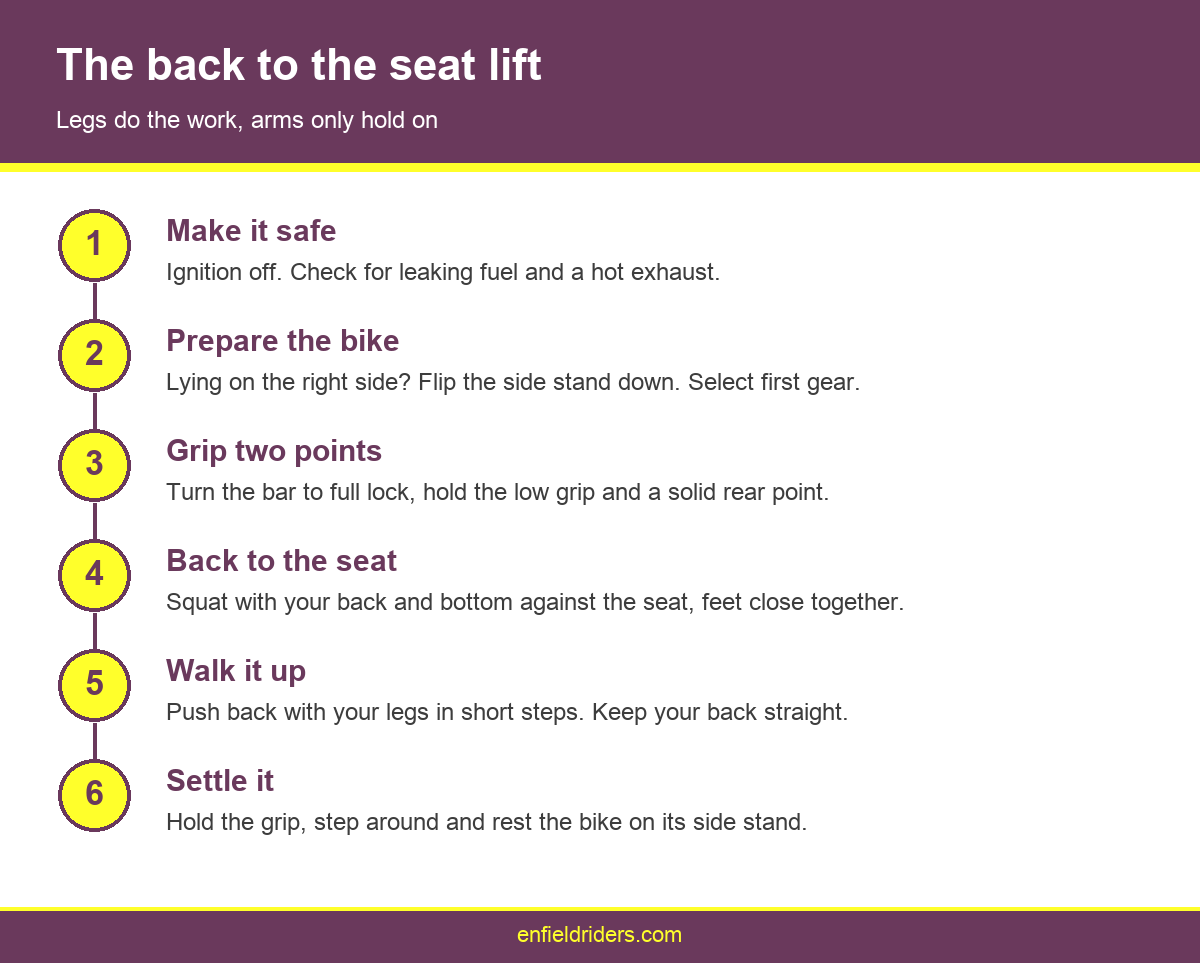
Turn the handlebar to full lock and hold the lower grip firmly. Squat with your back and bottom against the seat. Reach behind with your other hand and grip a solid point, such as the rear grab rail or frame. Keep your feet close together under you.
Now push backwards with your legs in short steps, as if you were sitting into a chair that keeps moving. Do not jerk or lift with your arms. The bike rises slowly. Once it is upright, keep a hand on the grip, step around and settle it on the side stand.
If your bike has an engine guard, it often rests at a shallower angle after a tip over. That makes the lift easier. Knowing how to lift a fallen motorcycle also means knowing when to ask for help. On a steep slope or soft mud, a second pair of hands is the safe choice.
Practise the lift once in a calm place before you ever need it. Ask a coach or friend to lay the bike down gently on an old mat in a quiet lot. Then lift it using the steps above while they stand beside you. The first attempt shows you how little arm strength the method needs.
Pushing a heavy Royal Enfield on flat roads and slopes
Pushing a heavy bike feels hard because most new riders hold it bolt upright and push with their arms. Lean the bike slightly towards you so it rests against your hip. Walk on the left side, hold both grips and keep a finger over the front brake. Your body moves the bike, not your shoulders.
Stand on the left of the bike with the gearbox in neutral and the ignition off. Hold both handlebar grips. Let the bike lean a few degrees towards you, so its weight rests on your hip and thigh. Now walk forward. Short, steady steps beat big shoves every time.
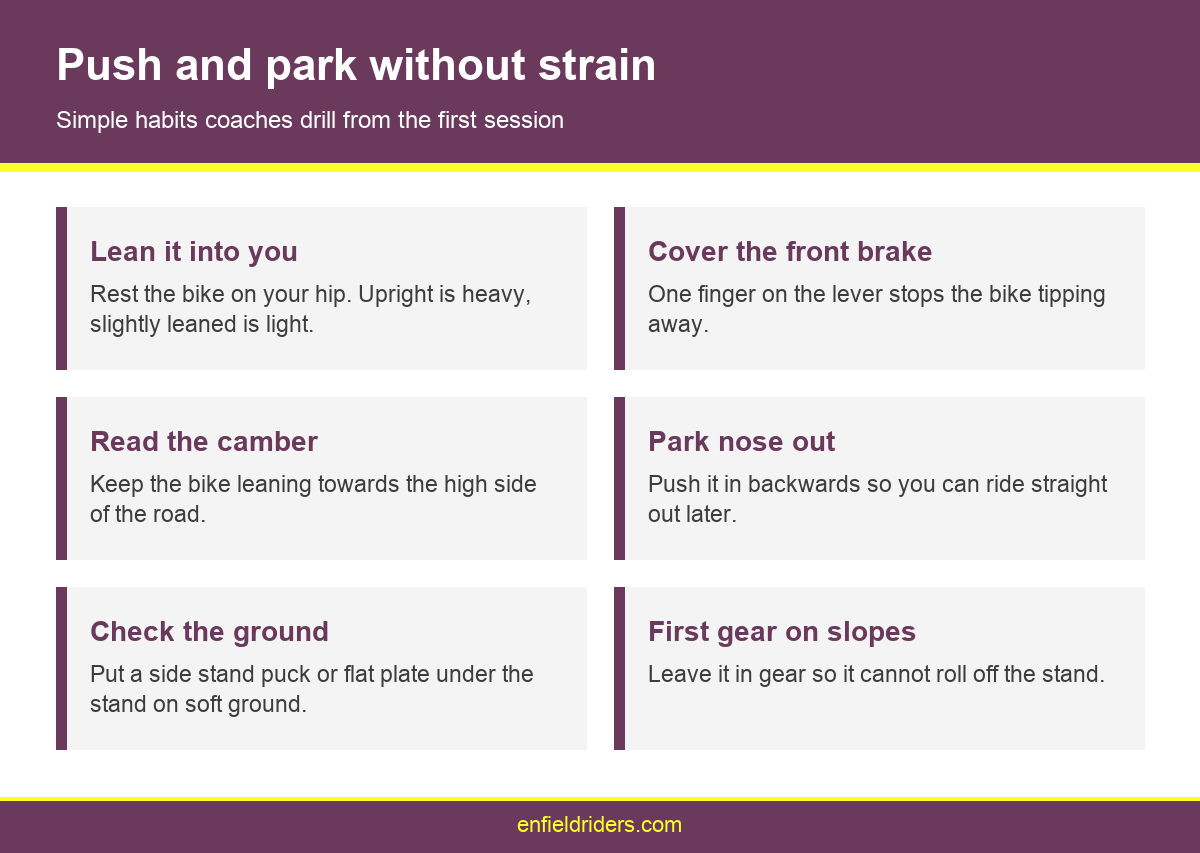
Your right hand stays on the throttle grip with a finger covering the front brake lever. That brake is your safety line. If the bike starts to tip away from you, squeeze it gently and the bike stops and comes back towards you.
Indian roads often slope towards the drain at the edge. When you push across that camber, keep the bike leaning into the uphill side. Going down a ramp, walk slowly and feather the front brake all the way. Going up, a friend pushing from the rear grab rail helps a lot.
Never let a heavy bike lean away from you past the point you can hold. Once it goes beyond that, let it go and step clear. It is far better to practise how to lift a fallen motorcycle later than to hurt your back trying to save one.
Turning the bike while pushing needs one extra habit. Look where you want to go, not at the front wheel. Turn the handlebar slowly and keep the lean towards you through the turn. A tight U turn on foot is far easier than one in the saddle, so walk the bike round when space is short.
Parking nose out, side stands and centre stands
Good parking saves you from awkward reversing later. Push the bike in backwards so it faces the road, choose firm ground for the stand and check the slope before you walk away. If your Royal Enfield has a centre stand, the right technique lifts it with body weight rather than arm strength.
Parking nose out means you push the bike into the space backwards. When you return, you ride straight out instead of reversing a heavy bike uphill. Reversing on foot beside the bike is easier than shuffling from the saddle, so do it while parking, when you have time.
Before you drop the side stand, look at the ground. Hot tar and soft mud let the stand sink. On a slope, the bike should lean into the hill, not away from it. Leave it in first gear so it cannot roll forward off the stand.
For a centre stand, hold the left grip with your left hand and the rear grab rail with your right. Place your right foot on the stand tang and press until both feet of the stand touch the ground. Then step down hard with that foot while pulling the bike back. Your weight does the lifting.
Each of these moves feels clumsy at first. After a few repetitions with a coach watching your feet and hips, they become automatic. That is exactly how riders who once feared how to lift a fallen motorcycle end up parking with confidence in busy city lanes.
Why technique beats strength on a 195 kg bike
Women and smaller riders often assume a heavy bike is not for them. Coaching shows otherwise. The Hunter 350 weighs 181 kg and the Classic 350 weighs 195 kg, but technique matters far more than the number. With body position and leg drive, riders of every build lift, push and park these bikes safely.
At Enfield Riders, we have spent 14 years coaching beginners on Royal Enfields. 20,000+ women have trained with us, and our learners have left 4,500+ verified reviews averaging 5 stars. Many arrived certain they could never handle the weight.
The fear usually comes from the first time a bike felt heavy at walking pace. Our post on first rides on a heavy Bullet explains why weight feels different once the bike moves. Slow handling is where most nerves live, so it deserves dedicated practice.
That is why weight handling is built into our 2 day Foundation course breakdown. Riders practise the lift on a bike laid down on purpose, with a coach beside them. Our judgment free classes for ladies take the same approach for first timers.
You can check current weights on Royal Enfield’s official Bullet 350 page. But knowing how to lift a fallen motorcycle is not about the figure on the spec sheet. It is about using the right muscles in the right order.
Conclusion
A tipped bike is part of learning, not a sign you are not ready. Learn how to lift a fallen motorcycle with your legs. Push it from the left with the bike leaning into you, and park nose out. Do all three and the weight stops ruling your rides. These skills take minutes to learn and a few sessions to own. Practise them with a coach beside you on the 12 hour Foundation course in Mumbai and ride away confident.
Frequently Asked Questions
How to lift a fallen motorcycle if I am not very strong?
Use the back to the seat method. Turn your back to the seat, hold the low grip and a rear frame point, then walk the bike up with your legs in short steps. Leg drive does the work, so upper body strength matters very little.
Can a woman lift a 195 kg Royal Enfield on her own?
Yes. Many women we coach lift a Classic 350 or Bullet 350 on their own once they learn the technique. Body position and leg drive matter far more than strength. A steep slope or soft ground is when to ask for help.
Should I put the bike in gear before lifting it?
Yes. Select first gear before you lift so the rear wheel cannot roll while the bike comes up. Switch the ignition off first, and if the bike lies on its right side, flip the side stand down before lifting.
Which side should I stand on when pushing a Royal Enfield?
Stand on the left side, hold both grips and let the bike lean slightly into your hip. Keep a finger over the front brake. If the bike starts tipping away, a gentle squeeze stops it and brings it back towards you.
What does parking nose out mean?
Parking nose out means pushing the bike into its space backwards so it faces the road. When you return, you ride straight out instead of reversing a heavy bike from the saddle, which is harder and riskier for new riders.
How do I park a Royal Enfield on a slope?
Park so the bike leans into the hill, not away from it, and leave it in first gear so it cannot roll forward. Check that the ground under the side stand is firm, since hot tar and soft mud let the stand sink.
Is it normal to drop the bike while learning?
Yes, low speed tip overs happen to many learners and rarely cause harm when you ride with proper gear. Practise the lift with a coach so a drop becomes routine. See what our learners say in our verified rider reviews.
Does an engine guard make a fallen bike easier to lift?
Often, yes. An engine guard usually holds the bike at a shallower angle after a tip over, so you start the lift from a higher point. It also protects the engine and your legs during a slow speed drop.
Where can I practise lifting and parking with a coach?
Weight handling is part of the Foundation course, run in Mumbai, Pune, Bangalore and other cities. Coaches lay a bike down on purpose so you can practise safely. Book through the Foundation course in Pune or your nearest city.
Frequently Asked Questions
Use the back to the seat method. Turn your back to the seat, hold the low grip and a rear frame point, then walk the bike up with your legs in short steps. Leg drive does the work, so upper body strength matters very little.
Yes. Many women we coach lift a Classic 350 or Bullet 350 on their own once they learn the technique. Body position and leg drive matter far more than strength. A steep slope or soft ground is when to ask for help.
Yes. Select first gear before you lift so the rear wheel cannot roll while the bike comes up. Switch the ignition off first, and if the bike lies on its right side, flip the side stand down before lifting.
Stand on the left side, hold both grips and let the bike lean slightly into your hip. Keep a finger over the front brake. If the bike starts tipping away, a gentle squeeze stops it and brings it back towards you.
Parking nose out means pushing the bike into its space backwards so it faces the road. When you return, you ride straight out instead of reversing a heavy bike from the saddle, which is harder and riskier for new riders.
Park so the bike leans into the hill, not away from it, and leave it in first gear so it cannot roll forward. Check that the ground under the side stand is firm, since hot tar and soft mud let the stand sink.
Yes, low speed tip overs happen to many learners and rarely cause harm when you ride with proper gear. Practise the lift with a coach so a drop becomes routine. See what our learners say in our verified rider reviews.
Often, yes. An engine guard usually holds the bike at a shallower angle after a tip over, so you start the lift from a higher point. It also protects the engine and your legs during a slow speed drop.
Weight handling is part of the Foundation course, run in Mumbai, Pune, Bangalore and other cities. Coaches lay a bike down on purpose so you can practise safely. Book through the Foundation course in Pune or your nearest city.
by
Tags: