
Your cart is currently empty!
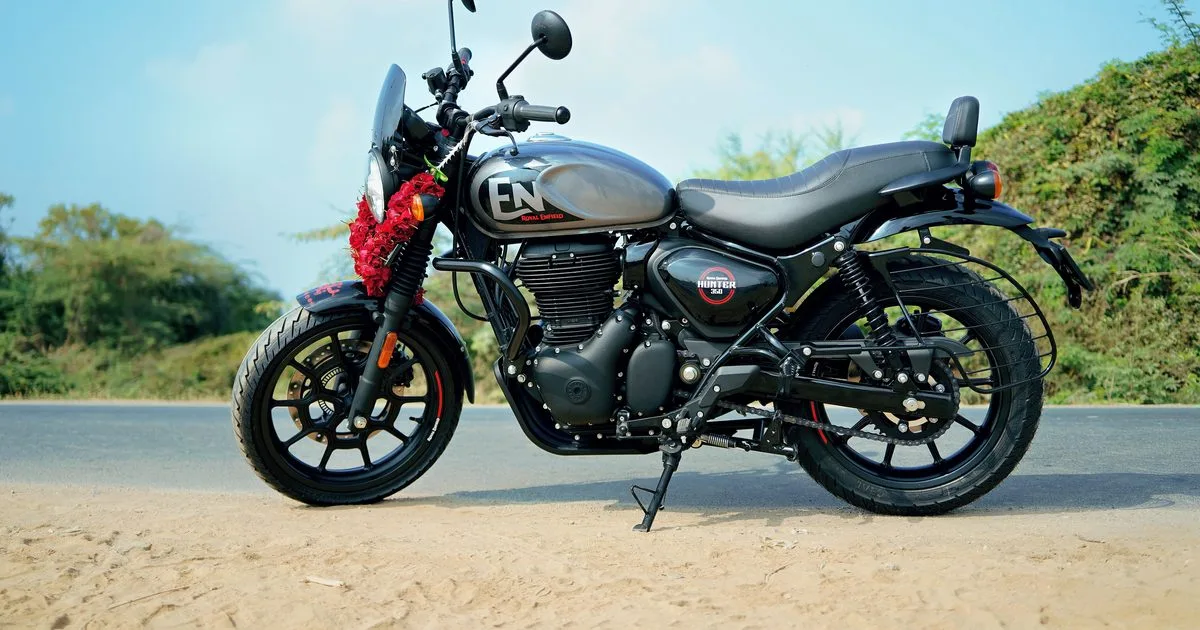
Royal Enfield Weight and Seat Height by Model: A Learner’s Guide
Royal Enfield weight is the first number most nervous beginners search for, usually late at night, usually before
booking anything. That is a fair question, and it deserves a straight answer from people who teach on these bikes
every day. Over 14 years of coaching, with 20,000+ women trained and 4,500+ verified reviews averaging 5 stars, we
have learnt what the spec sheet hides. This page puts every current 350 in one table, then explains what each figure
feels like. Our
Royal Enfield coaching programs turn those
numbers into skill.
Key Takeaways
-
Royal Enfield weight across the current 350s runs from 181 kg on the Hunter to 195 kg on the Classic and Bullet, and
balance matters far more than strength. -
The Bullet 350 weight is 195 kg with an 805 mm seat, yet a seat height you cannot flat foot is still a seat height
you can learn to manage. -
Coaching on a flat ground, at walking pace, is how the bullet bike weight stops feeling like a problem and starts
feeling like stability.
Royal Enfield Weight by Model: The Four 350s in One Table
Here are the figures for the four current 350s that most beginners meet first. We checked each one against the
official Royal Enfield spec pages on 2 October 2026. Specs can change between model years, so treat the maker’s page
as the final word.
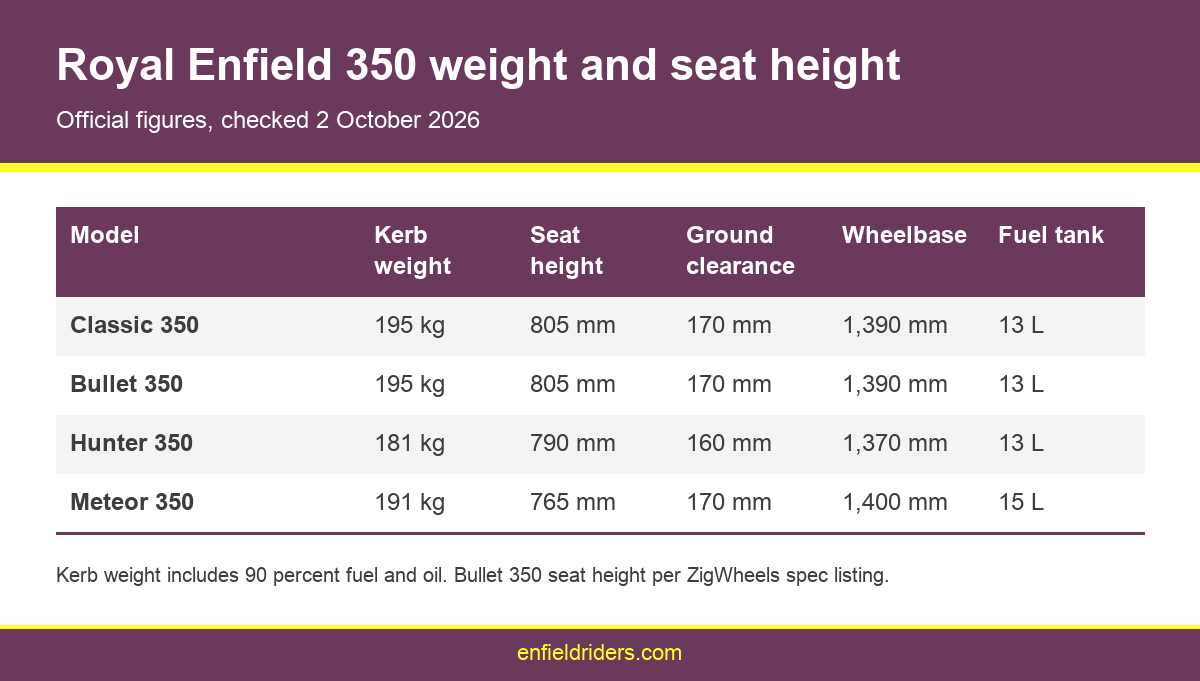
Kerb weight is the number that matters here. Royal Enfield defines it as the bike with 90 percent fuel and oil on
board, which is close to how you will actually ride it. You can confirm the details on the
official Classic 350 spec page and the
Bullet 350 model page.
Read the table slowly. The heaviest bikes in this group are the Classic 350 and the Bullet 350, both at 195 kg. The
Meteor 350 sits at 191 kg. The Hunter 350 is the lightest at 181 kg. That spread is real, but it is smaller than most
first timers imagine.
Seat height tells a different story from weight. The Meteor has the lowest seat at 765 mm, even though it is not the
lightest bike. The Hunter sits at 790 mm, and the Classic and Bullet both sit at 805 mm. So the lightest bike and the
lowest bike are not the same machine.
All four share the same 349cc single cylinder engine, which Royal Enfield calls the J series. All four use a 5 speed
gearbox with a left foot shift, one down and four up. None of the current 350s has a kick starter. Every one of them
starts with a button.
So when someone asks about Royal Enfield weight, the honest reply is a range, not a single number. The rest of this
guide explains why that range matters less than you fear, and which parts of it you will actually feel.
What Kerb Weight Actually Tells a New Rider
A number like 195 kg sounds like something you would need a gym membership to handle. It is not. Nobody lifts a
motorcycle while riding it. The tyres carry the load, and your job is to keep the bike balanced over them.
That is why we tell every nervous learner the same thing on day one. Royal Enfield weight is a fact about the bike,
not a test of your body. What you need is technique, timing and a calm head. Those three things can be taught.
Kerb weight versus the weight you feel
Kerb weight is measured with the bike standing still, fuel and oil inside. On the move, the bike feels nothing like
that figure. Once the wheels roll, the bike wants to stay upright on its own. The weight you feel comes mostly at two
moments: when the bike leans past its balance point at rest, and when you push it by hand. So the useful question is
not how heavy the bike is. It is how far it can lean before you have to work. On a 195 kg Classic, a small lean is
easy to hold. A big lean is not. Coaching teaches you to keep leans small.
Why weight distribution matters more than the total
Where the mass sits changes how heavy a bike feels. A bike with its weight carried low and central feels calmer at a
standstill than the total suggests. This is why two bikes with similar kerb weights can feel quite different in a
parking lot. The Meteor 350 at 191 kg sits low and tends to feel settled at a stop. The Hunter 350 at 181 kg feels
light and quick to turn. None of this is about strength. It is about how the bike’s centre of mass behaves when you
lean it a few degrees. Your coach will show you that feel before you ever ride.
The real job: balance, not muscle
When the bike is upright, its weight goes straight down into the tyres. You are holding almost nothing. The effort
appears only when the bike tips away from vertical. So the skill is spotting that tip early and stopping it while it
is small. A firm knee against the tank, eyes up, and a straight handlebar do most of the work. We teach the full
technique, step by step, in our
guide to first rides on a Bullet and handling its weight. This page stays with the numbers, so read that one when you want the method.
What You Feel Between 0 and 10 km/h
Almost every beginner worry about Royal Enfield weight lives below 10 km/h. At city speeds the bike is stable and the
weight helps you. It is the crawl, the stop and the tight turn that make new riders tense.
This is good news. Slow speed control is a small, specific set of skills, and it can be drilled on a flat training
ground until it becomes boring. Boring is the goal.
Pushing and parking by hand
Walking a 195 kg bike out of a parking spot is where many learners first meet the bullet bike weight. The trick is to
stand close, keep the bike nearly upright and let the wheels do the carrying. Push from your hips, not your arms. Keep
a finger on the front brake so you can stop the roll. Never push a bike leaning away from you. On a slope, take the
easy way out. Use the engine and clutch to move instead of muscling it. A coach will show you how to roll a bike
backwards safely while seated.
U turns and tight corners
A U turn at walking pace is the manoeuvre that scares beginners most, and for good reason. The bike leans, the speed
is low, and the weight wants to pull you over. The answer is steady drive from the clutch, a little rear brake to
control speed, and your head turned towards the exit. Look down at the front wheel and the bike follows your eyes into
the kerb. Clutch feel is the base skill here. Our
masterclass on the friction zone and clutch control
explains why slow drive keeps a heavy bike upright.
Stop and go traffic
In a Mumbai or Pune signal queue, you stop, wait, creep and stop again. Each stop is a moment where weight matters,
because the bike is balanced on your feet. Good stops start early. Brake gently, keep the handlebar straight, and put
your foot down only when the bike is almost still. A turned handlebar at a stop is the most common reason beginners
drop a bike. With practice, you will learn to stop with the bike nearly vertical every time. At that point the weight
barely registers.
Seat Height Versus Flat Footing
After Royal Enfield weight, seat height is the next number learners worry about. The current 350s range from 765 mm on
the Meteor to 805 mm on the Classic and Bullet. The Hunter sits between them at 790 mm.
Here is the honest part. Seat height alone does not decide whether your feet reach. Seat width matters, because a wide
seat pushes your legs apart and costs you reach. Suspension sag matters, because the bike settles once you sit on it.
Your inseam matters most of all.
That is why two riders of the same height can sit on the same bike and have very different reach. It is also why we
always ask learners to sit on a bike before deciding anything. A number on a page cannot tell you how a seat feels
under you.
Many riders worry they must plant both feet flat on the ground to be safe. That is not true. A rider who cannot flat
foot both feet can still ride safely using one foot stops. You shift slightly in the seat, put one foot down firmly,
and keep the other on the rear brake.
This one foot stop is a taught skill, not a trick. Shorter riders practise it from day one of coaching, on flat
ground, until it feels routine. It changes the conversation from whether you can reach to how you stop.
Many of the women we coach start with exactly this worry. You can see how they move from fear to calm control in our
article on
how female riders go from nervous to confident. The common thread is method, not height.
If you are choosing a bike, sit on all four and compare. Notice the seat width under your thighs, not just the height.
Then remember that technique closes most of the gap the numbers suggest.
Checking reach and sag on a test sit
Reading about Royal Enfield weight only gets you so far. Sit on the bikes, side by side, and pay attention to a few
specific things. Ten calm minutes tell you more than an hour of spec sheets. Sit with the bike off its stand while
someone holds it, or with a coach beside you. Let your weight settle and notice how far the suspension sinks. Then
check each foot. Can you reach the ground with both? With one foot firmly flat? Either answer is workable, because one
foot stops are taught on day one.
Checking lean and steering lock
Next, with help, lean the bike a few degrees towards your planted foot. Feel how quickly the weight builds. That small
lean is exactly the moment balance training is designed for. Then hold the handlebar at full lock both ways. Notice
whether you have to stretch. A long reach at full lock makes U turns harder, whatever the kerb weight says. None of
this is a test you pass or fail. It simply tells you which skills to practise first, and it gives your coach useful
information before your first session.
Bullet 350 Weight Compared With the Classic, Hunter and Meteor
The Bullet 350 weight is 195 kg, the same as the Classic 350. Both have an 805 mm seat, 170 mm ground clearance and a
1,390 mm wheelbase. On paper they are near twins, and in a training ground they feel similar too.
Below is how we explain each model to a beginner who asks which one to learn on. None of these is a recommendation to
buy. They are notes on what each bike’s numbers mean in your hands.
Classic 350 and Bullet 350
These two share the top of the Royal Enfield weight range at 195 kg. They also share the tallest seat in the group.
That combination makes slow work the main learning task. The upside is stability. A heavier bike with a long wheelbase
feels planted once it rolls, and many learners grow to love that calm. The Classic makes 20.2 bhp at 6,100 rpm and 27
Nm at 4,000 rpm, according to the
Royal Enfield Classic 350 specifications.
That smooth, low pull is forgiving when your clutch hand is still learning.
Hunter 350
The Hunter 350 is the lightest of the four at 181 kg, with a 790 mm seat and a 1,370 mm wheelbase. You can check the
figures on the Hunter 350 model page. Lower
weight and a shorter wheelbase make the Hunter quick to turn at walking pace. Learners often find U turns easier to
start on it. The trade off is that it responds faster to every input. A jumpy throttle hand shows up quickly. Good
clutch control matters just as much here as on the heavier bikes.
Meteor 350
The Meteor 350 weighs 191 kg but has the lowest seat at 765 mm, plus the longest wheelbase at 1,400 mm and a 15 L
tank. The Meteor 350 spec page lists the full
details. For shorter riders, that low seat is the headline. Reaching the ground with confidence makes every stop feel
calmer. The relaxed, feet forward riding position takes a short adjustment for some learners, because your feet sit
further ahead. Coaches show you where to place them at each stop.
Learning on an Older Family Bullet
Many learners do not start on a new bike at all. They start on the family Bullet, or a second hand Classic bought from
a friend. Those older generations can feel quite different from the current J series 350s.
The biggest difference is often the start. No current 350 has a kick starter, and the new Bullet 350 is self start
only. Earlier models may have a kick lever, and some very old Bullets have their own starting routine.
If you are handed one of those, do not guess. On very old Bullets, ask the owner or a mechanic how that particular
bike starts. A coach can then help you practise it safely on the ground before you ride.
Weight figures for older bikes also differ from the table above, and we only quote current official numbers here. So
do not assume the family bike matches today’s Bullet 350 weight. Sit on it, rock it gently from side to side, and
notice how it feels compared with a newer model.
Gear patterns, brake feel and seat shape may also differ on earlier models. That is one more reason to learn the core
skills first, on a training bike, and then carry them across. Balance, clutch control and upright stops work on any
Royal Enfield. Once those are in your hands, an older bike becomes a new flavour, not a new fear.
Numbers a Beginner Can Safely Ignore
Spec sheets are full of figures, and nervous learners tend to read every one as a warning. Most of them do not matter
in your first weeks of riding. Here is how we sort them.
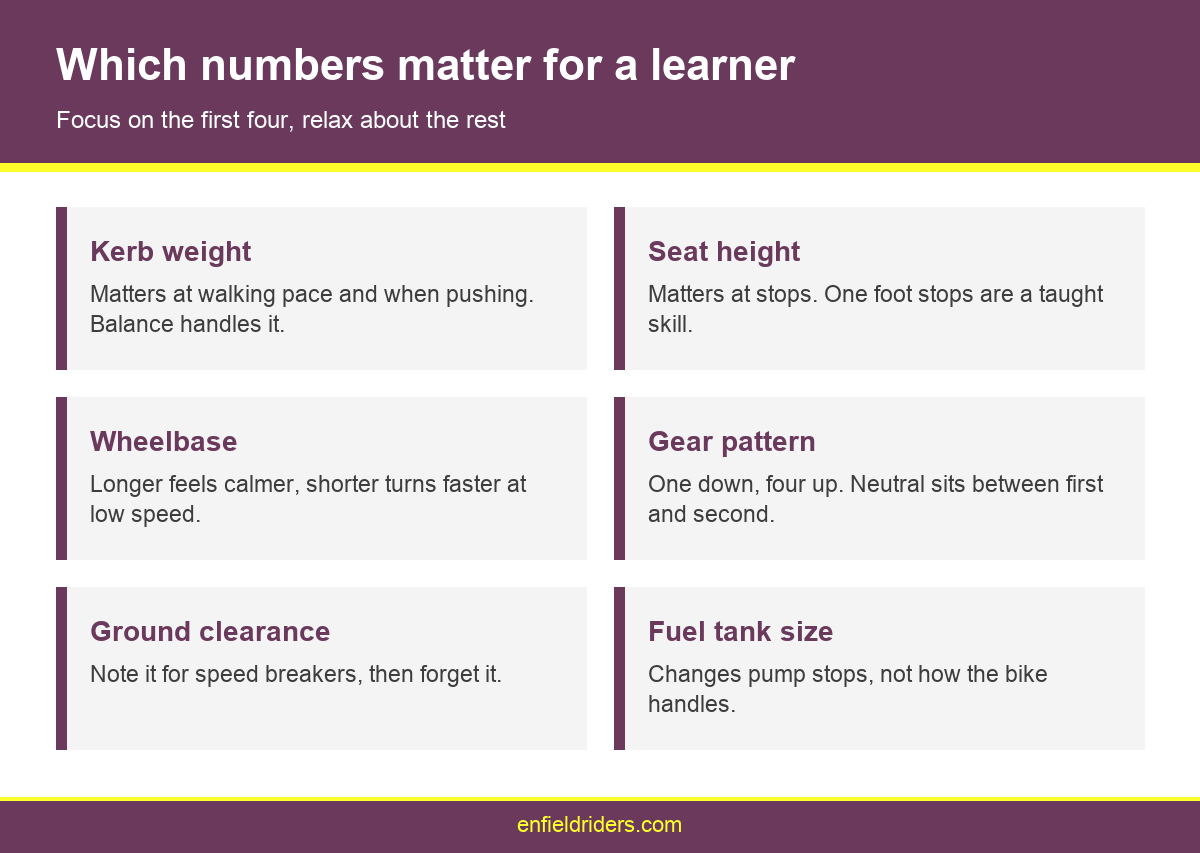
Ground clearance is one to note and then forget. The Hunter sits at 160 mm, the others at 170 mm. That matters over
large speed breakers, not in learning to ride. Approach breakers slowly and straight, and either figure is fine.
Fuel tank size changes how often you stop at a pump. It does not change how you ride. A full 15 L tank on the Meteor
adds a little weight, but kerb weight already counts it at 90 percent.
Power figures matter even less to a learner. All four bikes share the same 349cc engine, so none is a big jump from
another. Smooth inputs matter far more than peak numbers.
Two things are worth more attention than any spec. The first is the gear pattern, one down and four up, with neutral
between first and second. The second is your licence. Learner’s licence first, then the RTO test for the permanent
one.
For the official process, start at the Parivahan Sewa portal. For the
practical side, read
our guide to getting your licence in India, which walks through how training and the RTO test fit together.
One more figure deserves a mention: wheelbase. A longer wheelbase, like the Meteor’s 1,400 mm, tends to feel calm and
steady. A shorter one, like the Hunter’s 1,370 mm, turns a little quicker at walking pace. Neither is better. They
simply feel different.
Ignore the rest until you are riding comfortably. Numbers become interesting once you have the skill to feel them.
Before that, they mostly feed worry.
How Coaching Turns Royal Enfield Weight Into Confidence
Numbers are useful, but they do not teach you to ride. A coach does. Over 14 years we have watched the same pattern
again and again. A learner arrives worried about Royal Enfield weight, and leaves worried about something new, like
which gear to pick for a flyover.
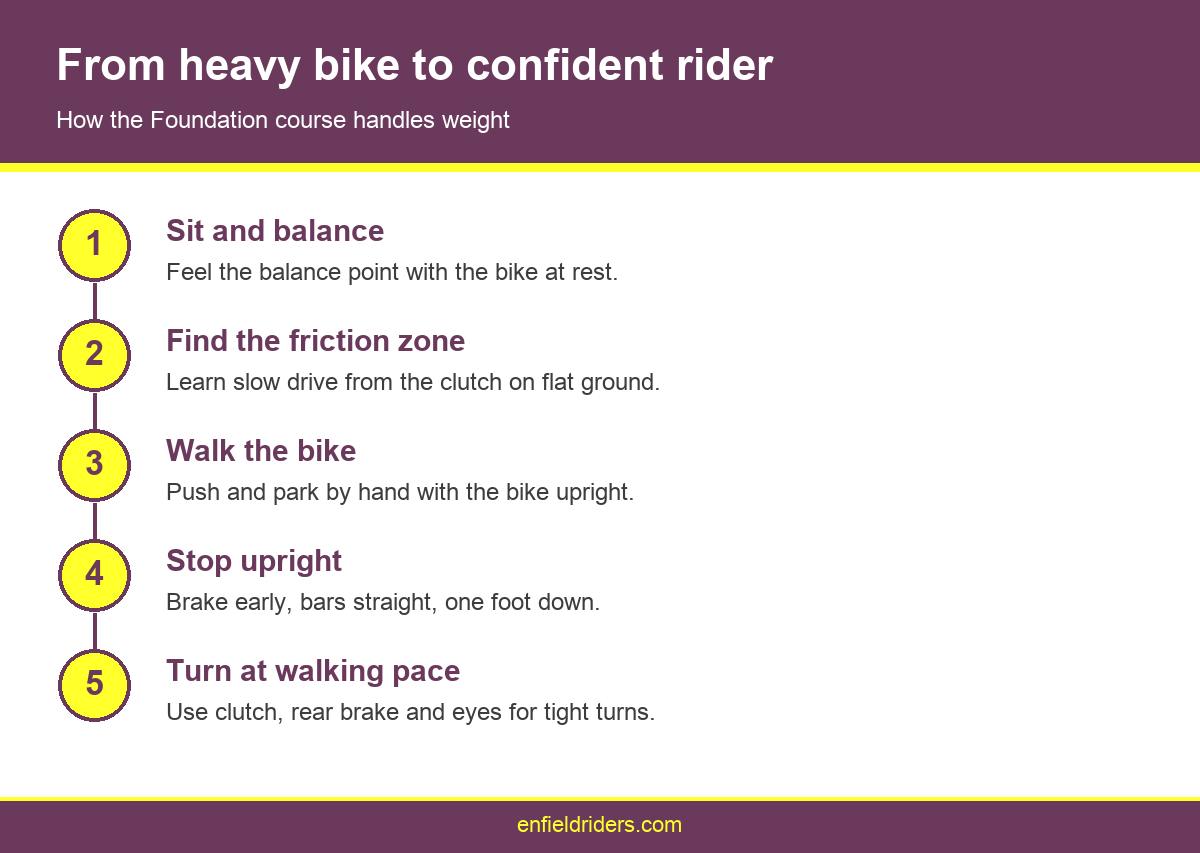
Our Foundation course runs 12 hours over 2 days, with 1 coach to 4 riders. You start on flat, open ground. You learn
to balance the bike at rest, find the clutch friction zone, move at walking pace and stop with the bike upright. The
Foundation course in Pune
follows the same structure as every other city.
Your coach watches your feet, hands and eyes the whole time. Small corrections come early, before a habit sets. If a
drill feels too much, you repeat the step before it until it feels easy again. Nobody is hurried along to keep pace
with the group.
We never rush the slow work. Pushing, parking, U turns and one foot stops all come before speed. That order is
deliberate, because those are the exact moments where the weight lives.
If you want to see how each session unfolds, our
two day breakdown of the Foundation course
covers every block. After Foundation, the Advanced course adds 8 hours over 2 days at 1 coach to 3 riders.
Personalised coaching is 3 hours, one to one.
Our coaching is women first and judgment free, and we coach men and women both. In all, 20,000+ women have trained
with us, and our 4,500+ verified rider reviews average 5 stars.
Many of them start with the same question you are asking now.
Conclusion
Royal Enfield weight sounds big on paper, from 181 kg on the Hunter to 195 kg on the Classic and Bullet. In practice
it is a balance problem, and balance is a skill anyone can learn. Seat height works the same way, because one foot
stops are taught, not inherited. With 14 years of coaching behind us, 20,000+ women trained and 4,500+ verified
reviews averaging 5 stars, we know the fear well. Book the
12 hour Foundation course in Mumbai
and let a coach show you how calm a heavy bike can feel.
Frequently Asked Questions
What is the Royal Enfield weight for each 350 model?
Official kerb weights are 195 kg for the Classic 350 and Bullet 350, 191 kg for the Meteor 350 and 181 kg for the
Hunter 350. Kerb weight includes 90 percent fuel and oil, so it is close to riding weight.
What is the Bullet 350 weight?
The current Bullet 350 has a kerb weight of 195 kg, the same as the Classic 350. It also shares the 805 mm seat
height. Balance and slow speed technique matter far more than strength when handling it.
What is the Bullet 350 cc weight with fuel?
Royal Enfield quotes kerb weight with 90 percent fuel and oil, and for the Bullet 350 cc model that figure is 195 kg.
A completely full tank adds only a little extra, which you will not notice on the move.
Is the bullet bike weight too heavy for a beginner?
No. The weight feels heavy only at a standstill or when pushing the bike. Once rolling, it helps stability. Beginners
learn to keep the bike upright at stops, which removes most of the effort from handling it.
Which Royal Enfield 350 is the lightest?
The Hunter 350 is the lightest current 350 at 181 kg. It also has a shorter wheelbase, so it turns quickly at walking
pace. That said, every 350 can be learnt with good clutch control and balance.
What is the seat height of the Royal Enfield 350s?
The Meteor 350 is lowest at 765 mm, the Hunter 350 sits at 790 mm, and the Classic 350 and Bullet 350 sit at 805 mm.
Seat width, suspension sag and your inseam also change how far you reach.
Can I ride a Royal Enfield if I cannot touch the ground flat footed?
Yes. Riders who cannot flat foot both feet ride safely using one foot stops. You shift slightly in the seat and plant
one foot firmly. It is a taught skill, and
our coaching background spans 14 years.
Do current Royal Enfield 350s have a kick starter?
No. None of the current 350s has a kick starter, including the new Bullet 350, which is self start only. Kick starters
belong to older generations that learners sometimes meet as family or second hand bikes.
How long does it take to get comfortable with a heavy Royal Enfield?
Most of the slow speed work is covered in the Foundation course, which runs 12 hours over 2 days with 1 coach to 4
riders. Get in touch to book a session in your city.
Frequently Asked Questions
Official kerb weights are 195 kg for the Classic 350 and Bullet 350, 191 kg for the Meteor 350 and 181 kg for the Hunter 350. Kerb weight includes 90 percent fuel and oil, so it is close to riding weight.
The current Bullet 350 has a kerb weight of 195 kg, the same as the Classic 350. It also shares the 805 mm seat height. Balance and slow speed technique matter far more than strength when handling it.
Royal Enfield quotes kerb weight with 90 percent fuel and oil, and for the Bullet 350 cc model that figure is 195 kg. A completely full tank adds only a little extra, which you will not notice on the move.
No. The weight feels heavy only at a standstill or when pushing the bike. Once rolling, it helps stability. Beginners learn to keep the bike upright at stops, which removes most of the effort from handling it.
The Hunter 350 is the lightest current 350 at 181 kg. It also has a shorter wheelbase, so it turns quickly at walking pace. That said, every 350 can be learnt with good clutch control and balance.
The Meteor 350 is lowest at 765 mm, the Hunter 350 sits at 790 mm, and the Classic 350 and Bullet 350 sit at 805 mm. Seat width, suspension sag and your inseam also change how far you reach.
Yes. Riders who cannot flat foot both feet ride safely using one foot stops. You shift slightly in the seat and plant one foot firmly. It is a taught skill, and our coaching background spans 14 years.
No. None of the current 350s has a kick starter, including the new Bullet 350, which is self start only. Kick starters belong to older generations that learners sometimes meet as family or second hand bikes.
Most of the slow speed work is covered in the Foundation course, which runs 12 hours over 2 days with 1 coach to 4 riders. Get in touch to book a session in your city.
by
Tags: