
Your cart is currently empty!
Royal Enfield for Short Riders: Flat Footing and One Foot Stops
Most advice on a Royal Enfield for short riders stops at one question: which model has the lowest seat? That matters, but it is only half the answer. The other half is technique, and technique is something you can learn this month. Riders of every height ride these bikes well because they know where to put one foot, when to slide over and how to move the bike without strain. Start with the numbers in our guide to weight and seat height by model, then come back here for the skills.
Key Takeaways
- Choosing a Royal Enfield for short riders starts with seat height, but seat width, suspension sag and your inseam decide real reach.
- One foot stops, picking the higher side for your down foot and sliding off the seat let short riders stop with confidence.
- Reversing is easier on foot beside the bike than from the saddle, and every one of these skills is drilled in coaching.
Choosing a Royal Enfield for short riders: seat height first
Seat height is the first number short riders check, and it is a useful start. Yet two bikes with similar seat heights can feel very different. Seat width, how much the suspension sinks under you and your own inseam all change how much foot reaches the ground. Test the bike, not only the brochure figure.
Among the current 350s, the Meteor 350 sits lowest at 765 mm. The Hunter 350 follows at 790 mm. The Classic 350 is 805 mm, and the Bullet 350 is listed at 805 mm too. You can check the Meteor figures on Royal Enfield’s official Meteor 350 page.
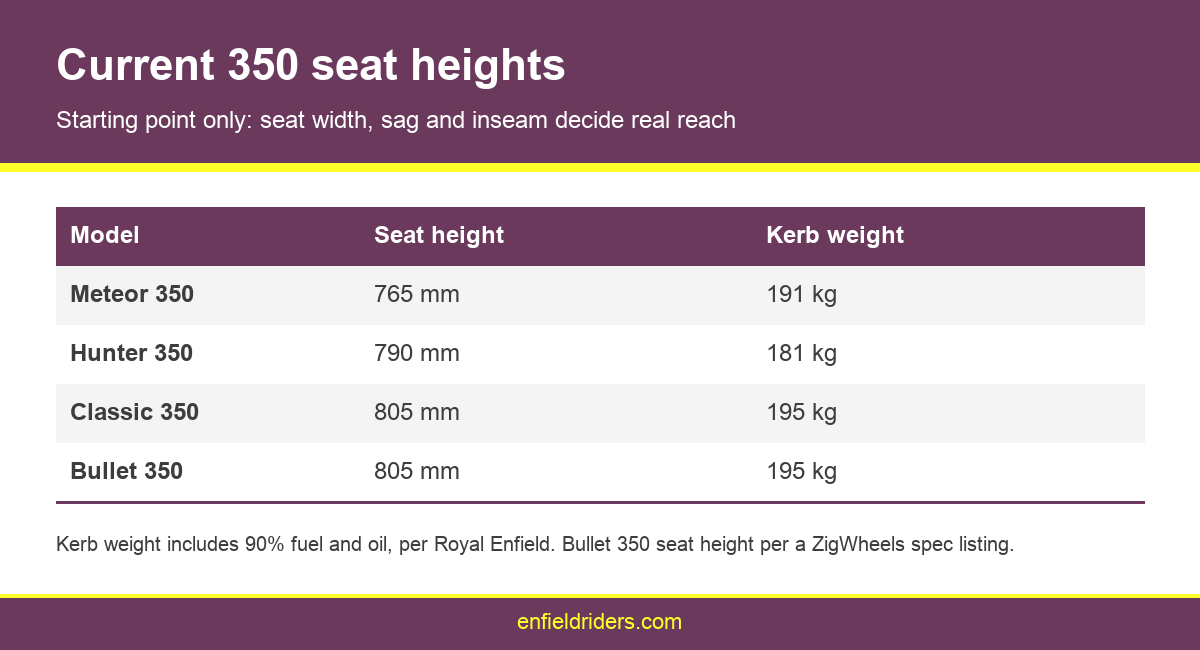
A wide seat spreads your legs apart, so your feet travel further to reach the road. A narrower front edge of the seat brings them closer together and lower. The suspension also sinks a little once you sit, which helps. That is why a quick sit on the actual bike tells you more than any chart.
Here is the part brochures skip. A rider who cannot flat foot both feet can still ride safely. One foot stops are a taught skill, and they are how many experienced riders stop every day. Looking for a Royal Enfield for short riders should never mean ruling yourself out of the model you love.
Weight matters alongside height, because a lighter bike is easier to hold on one foot. The Hunter 350 has a kerb weight of 181 kg, the lightest of the four. The Classic and Bullet are 195 kg. When you test sit, ask someone to hold the bike while you rock it gently from side to side. Notice which leg feels steady and which stretches.
One foot stops and choosing your down foot
A one foot stop means you hold the bike upright on one foot while the other stays on its peg. It is the core skill for any Royal Enfield for short riders. The trick is deciding early which foot goes down, based on the slope of the road, and keeping the handlebar straight as you stop.
Most riders put the left foot down at a stop. The right foot stays on the peg and holds the rear brake. This keeps the bike steady and ready to move off. Before you stop, slide your hips slightly to the left so your left leg gains reach.
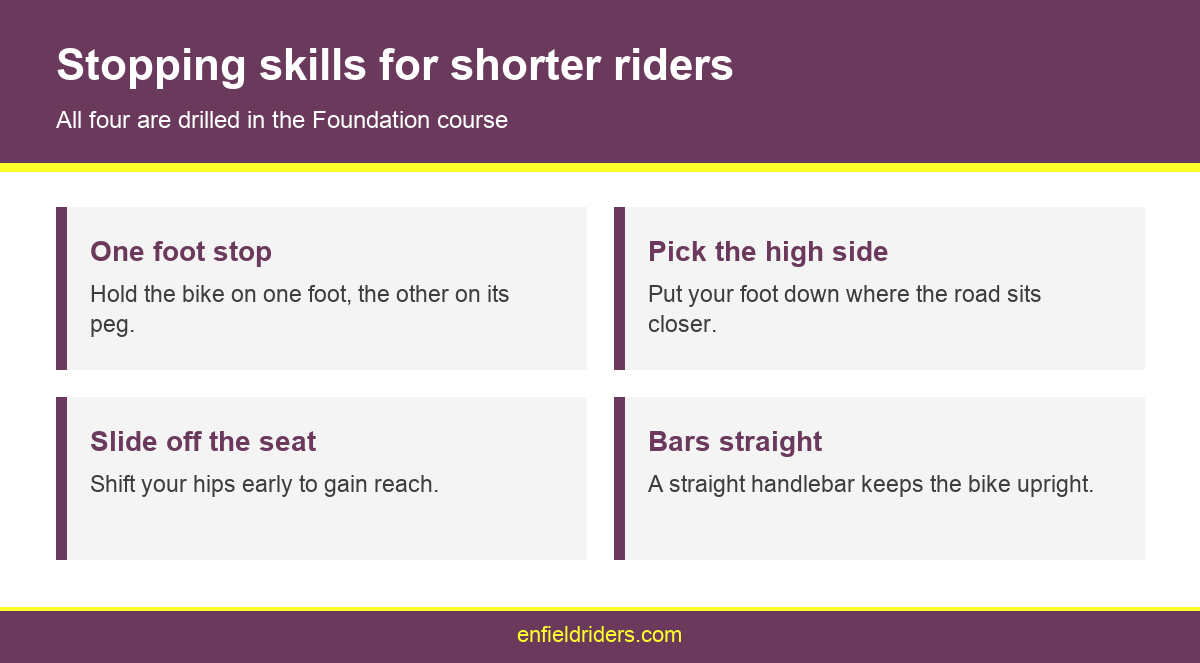
Indian roads are rarely flat at the edge. Many slope down towards the drain or kerb, so the ground on the low side sits further away. Look at where you will stop before you get there. Put your foot down on the higher side, where the road meets you sooner.
If the higher side is on your right, hold the bike on the front brake and put the right foot down. Keep the handlebar straight. A turned bar makes the bike fall towards the turn. Also avoid stopping with your foot on gravel, oil, a drain cover or a pothole.
Practise the decision before you need it. On a quiet road, call out the high side aloud each time you slow down. Within a few rides, your eyes start reading the camber on their own. That habit matters most at busy signals, where you have little time to choose. It also helps on bus stop bays, where the road often tilts towards the footpath.
Sliding off the seat to gain reach
Sliding off the seat means shifting one hip slightly off the saddle as you stop, so your down leg gains reach. It is a small move with a big effect. Done early and smoothly, it lets a shorter rider plant a firm foot instead of stretching on tiptoe at the last second.
Start the slide before the bike stops, while it is still rolling slowly and upright. Move your hips towards the side where your foot will go down. Keep your upper body tall and your eyes up, not on the ground. Looking down pulls the bike off balance.
Do not tip the bike to meet your foot. Keep it upright and let your body do the moving. When you move off again, slide back to the centre of the seat as you lift your foot. Your coach will practise this at walking pace until the motion feels natural.
This is where a good coach saves weeks of worry. Our coaches have taught this for 14 years, to riders of every height and build. If you have read about bike weight and first ride confidence and wondered whether the bike is simply too big, take heart. With the right stance, it usually is not.
Combine the slide with a gentle, early stop. A late, sharp stop gives you no time to shift, and the bike arrives before your foot does. Brake smoothly and plan the last few metres. If you ride with a pillion later, the slide still works, though your coach will add a few drills for the extra weight.
Walking the bike backwards without strain
Reversing from the saddle is the hardest move for a short rider, because your feet cannot push firmly. The safer way is to step off and walk the bike from the left side. Keep it in neutral, lean it gently against your hip and cover the front brake. Better still, park so you rarely need to reverse.
Stand on the left side of the bike, close to it. Hold both grips with your hands. Lean the bike slightly towards you so it rests against your hip. Your body, not your arms, carries the weight. Move slowly in small steps, with a finger ready on the front brake.
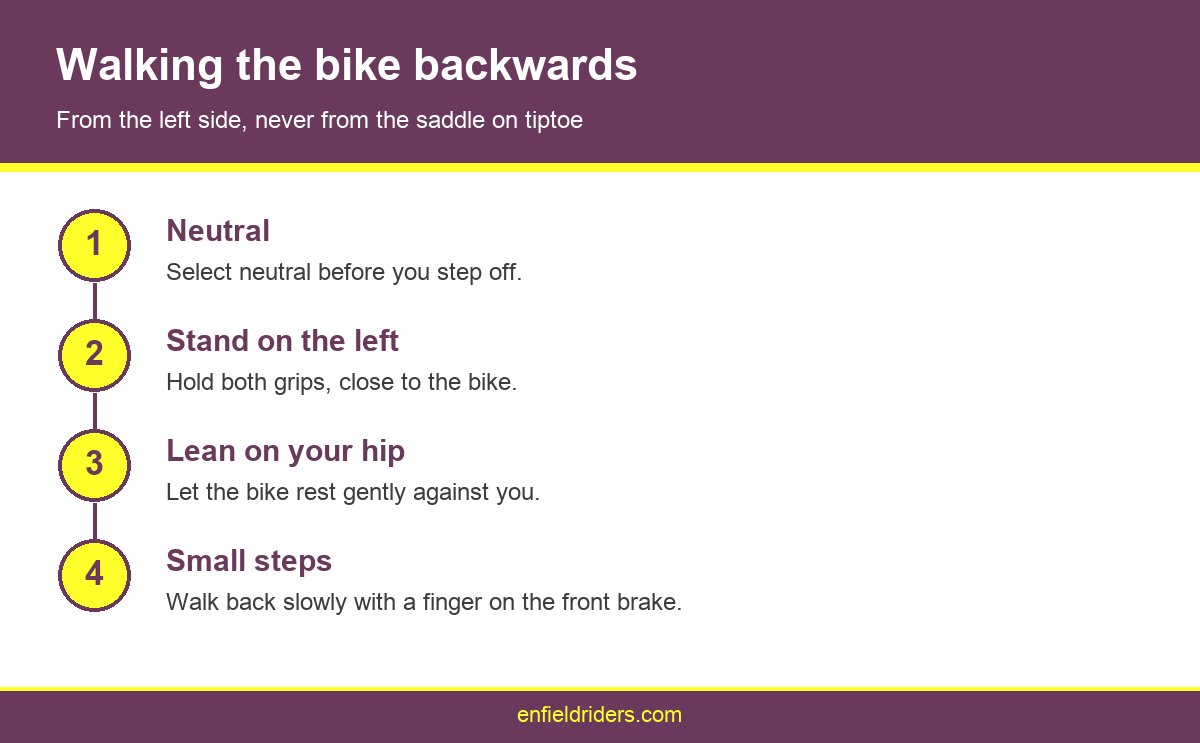
Planning saves effort. When you park, think about how you will leave. Nose out on level ground is easiest for you. Avoid parking where the road slopes down towards the front wheel, because rolling back uphill on foot is hard work for anyone.
These are all skills, not gifts, and we have seen that across 20,000+ women trained through our Women Motorcycle Coaching Academy. Our nervous to confident coaching guide explains how we pace them. You can also read 4,500+ verified reviews averaging 5 stars from riders who once doubted their reach.
Moving forward on foot works the same way. Push the bike from the left side with the same lean against your hip, and keep the front brake covered. Never stand on the low side of a sloping road while you walk the bike. If it starts to tip away from you, let it go rather than risk your back. A dropped bike can be lifted safely with the right technique.
Conclusion
Choosing a Royal Enfield for short riders is about more than the seat height figure. Pick a bike that feels right when you sit on it, then learn the skills that make height a small detail. One foot stops, choosing the higher side, sliding off the seat and reversing on foot are all drilled in our 1:4 Foundation course. Your coach watches each stop and adjusts your timing. Join the 12 hour Foundation course in Mumbai and ride the bike you actually want.
Frequently Asked Questions
Which Royal Enfield for short riders has the lowest seat?
Among the current 350s, the Meteor 350 has the lowest seat at 765 mm. The Hunter 350 is 790 mm, and the Classic 350 is 805 mm. Sit on each bike, because seat width and sag also change reach.
Do I need both feet flat on the ground to ride safely?
No. A rider who cannot flat foot both feet can still ride safely with one foot stops. It is a taught skill. You hold the bike on one foot while the other rests on the peg.
Which foot should I put down at a stop?
Usually the left, so your right foot can hold the rear brake. On a sloping road, put the foot down on the higher side. If that is the right, hold the bike on the front brake.
How do I reverse a heavy motorcycle if I am short?
Step off and walk it from the left side. Keep it in neutral, hold both grips and lean it gently against your hip. Move in small steps with a finger covering the front brake.
Can a 5 foot rider learn on a Royal Enfield?
Many shorter riders learn successfully with the right technique and a bike that suits them. Your coach checks your reach on day one and adjusts the drills. Our coaching programmes from Foundation to Personalised cover every stage.
Does seat height alone decide if a bike fits me?
No. Seat width, suspension sag and your inseam all matter. A narrow front edge on the seat can help your feet reach lower. Always sit on the actual bike before you decide whether it suits you.
What is sliding off the seat on a motorcycle?
It means shifting one hip slightly off the saddle as you slow down, so your down leg reaches further. Keep the bike upright and your eyes up. Start the move early, while the bike is still rolling.
Where can I practise these skills with a coach?
Every skill here is drilled in our Foundation course, which runs 12 hours over 2 days with one coach for four riders. You can join the Foundation course in Pune if you live nearby.
Frequently Asked Questions
Among the current 350s, the Meteor 350 has the lowest seat at 765 mm. The Hunter 350 is 790 mm, and the Classic 350 is 805 mm. Sit on each bike, because seat width and sag also change reach.
No. A rider who cannot flat foot both feet can still ride safely with one foot stops. It is a taught skill. You hold the bike on one foot while the other rests on the peg.
Usually the left, so your right foot can hold the rear brake. On a sloping road, put the foot down on the higher side. If that is the right, hold the bike on the front brake.
Step off and walk it from the left side. Keep it in neutral, hold both grips and lean it gently against your hip. Move in small steps with a finger covering the front brake.
Many shorter riders learn successfully with the right technique and a bike that suits them. Your coach checks your reach on day one and adjusts the drills. Our coaching programmes from Foundation to Personalised cover every stage.
No. Seat width, suspension sag and your inseam all matter. A narrow front edge on the seat can help your feet reach lower. Always sit on the actual bike before you decide whether it suits you.
It means shifting one hip slightly off the saddle as you slow down, so your down leg reaches further. Keep the bike upright and your eyes up. Start the move early, while the bike is still rolling.
Every skill here is drilled in our Foundation course, which runs 12 hours over 2 days with one coach for four riders. You can join the Foundation course in Pune if you live nearby.
by
Tags: